Most claims professionals know a litigated claim costs far more than one that settles early. What Sedgwick’s data adds is when that outcome gets locked in — and the answer is: almost immediately. We asked Sedgwick’s Chief Claims Officer, K. Max Koonce, what the numbers say about attorney representation, the litigation cost multiple, nuclear verdicts, and what an insured should actually do differently. His through-line: outcomes are increasingly determined before most organizations have finished their first investigation call.

“Most claims that will litigate have counsel within the first two weeks. What should an insured do in those two weeks?”
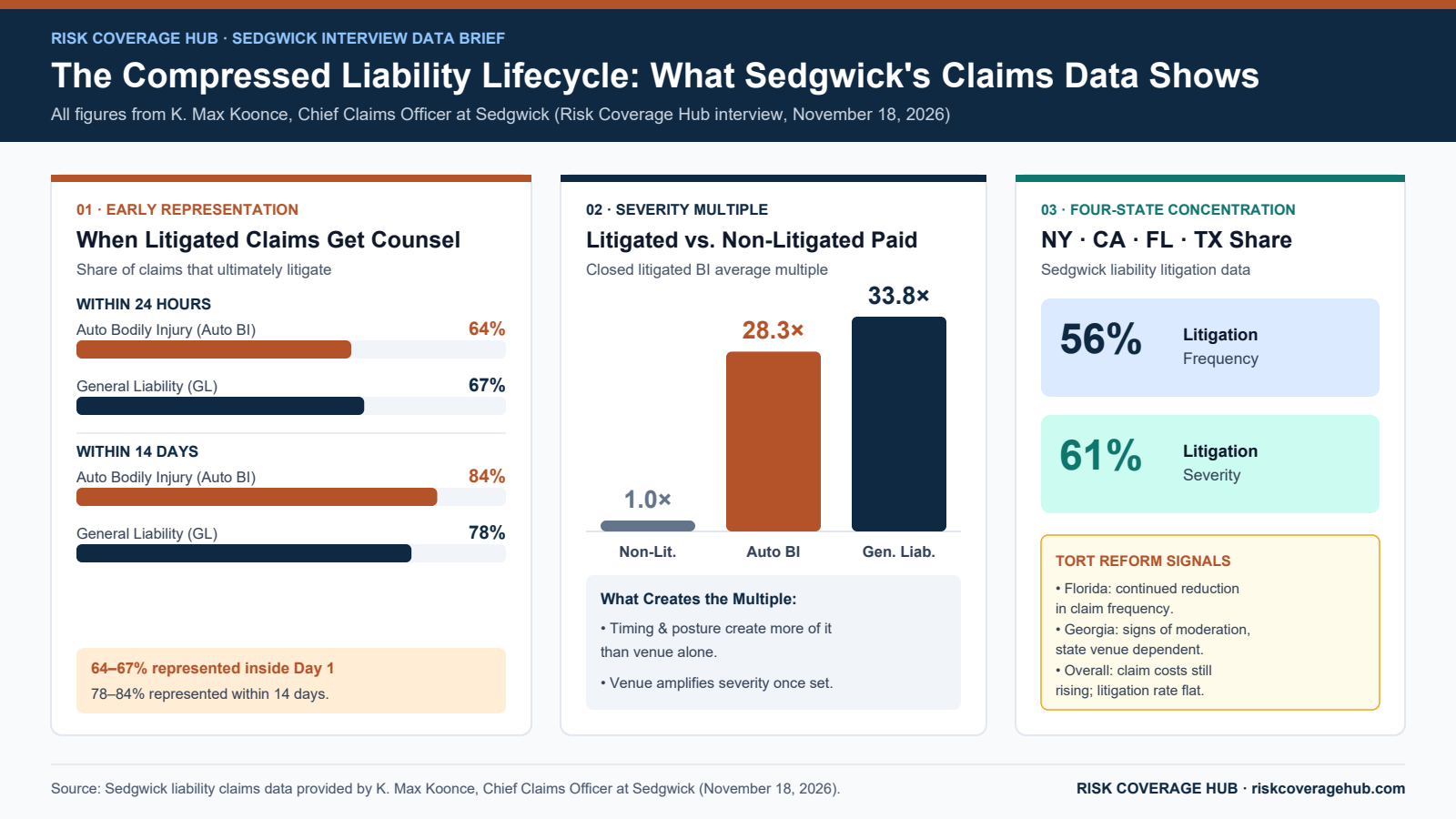
Many would answer this question as “investigate the claim” — which obviously must be done — but the focus must also be on establishing control over the claim trajectory. Sedgwick data shows that 84% of Auto BI claims that ultimately litigate have attorney representation within 14 days, and 78% of litigated GL claims have representation within 14 days. In Auto, 64% are represented within 24 hours; in GL, 67% are represented within 24 hours. That means an insured’s most important opportunities are front-loaded.
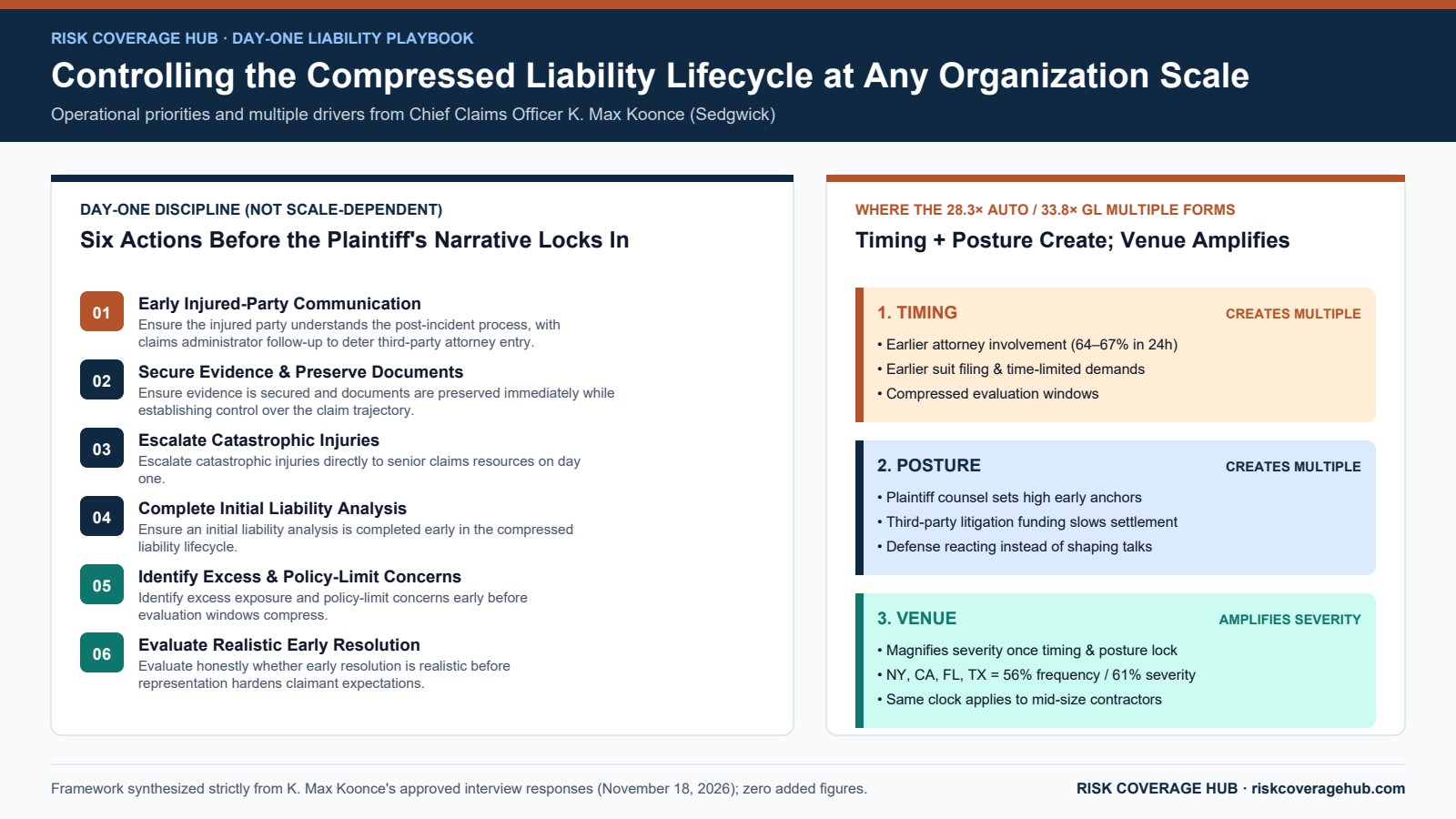
One of the most critical factors in avoiding attorney representation revolves around the initial communication with the injured party. Ensuring the individual is aware of the process that will follow once an incident occurs and is reported, with follow-up from the claims administrator, helps deter the need for a third party — an attorney — becoming involved in the process.
As to the incident itself, insureds should ensure that:
- Evidence is secured and documents are preserved.
- Catastrophic injuries are escalated to senior claims resources.
- An initial liability analysis is completed.
- Excess exposure and policy-limit concerns are identified.
- Whether early resolution is realistic is evaluated.
Once representation occurs, claimant expectations become harder to influence. The objective is preventing the plaintiff’s narrative from becoming the only narrative. What we are seeing is a “compressed liability lifecycle,” where outcomes are increasingly determined through early positioning and negotiation.
“Litigated claims cost far more than non-litigated ones. Where is that multiple actually created — venue, timing, or posture?”
The answer is all three, but timing and posture are creating more of the multiple than venue alone. For auto liability, closed litigated BI claims average 28.3 times the paid amount of non-litigated claims. For general liability, closed litigated BI claims average 33.8 times the paid amount of non-litigated claims.
The multiple emerges through:
Timing — Earlier attorney involvement. Earlier suit filing. Time-limited demands. Compressed evaluation windows.
Posture — Plaintiff attorneys establishing high anchors early. Third-party litigation funding reducing settlement urgency. Defense organizations reacting rather than shaping negotiations.
Venue — Venue amplifies the severity once timing and posture are already established. New York, California, Florida, and Texas are driving a disproportionate amount of litigation frequency and severity: those four states account for 56% of frequency and 61% of severity in Sedgwick’s liability data.
“Nuclear verdicts and social inflation: which jurisdictions are genuinely getting worse, and is tort reform moving any of it?”
As noted, Sedgwick data indicates that New York, California, Texas, and Florida are generating the majority of both frequency and severity.
Tort reform is moderating some behaviors. Looking at the most recent states to enact it: for Florida, our data points to a continued reduction in claim frequency. Additionally, per the Marathon Strategies 2025 Nuclear Verdicts report, Florida has dropped in its rankings of the worst jurisdictions. For Georgia, there are signs of moderation in outcomes, although it remains state venue dependent.
However, the data clearly shows that claim and lawsuit costs continue to increase, and although our overall litigation rate remains relatively flat, for claims that proceed into litigation, attorneys are involved very early in the process.
“What should a mid-size contractor — not a Sedgwick-scale program — do differently on day one of a serious claim?”
The same things, per Koonce: his answer to this question points back to the first. The day-one discipline — control the trajectory, communicate with the injured party before a plaintiff’s narrative forms, secure the evidence, run the liability analysis, surface excess exposure early, and honestly evaluate early resolution — is not scale-dependent. The compressed liability lifecycle applies to a mid-size contractor’s claim on the same clock it applies to a national program’s: the representation decision is largely made within 24 hours to 14 days either way.
Key takeaways
- 64–67% of claims that will litigate have an attorney within 24 hours; 78–84% within 14 days (Sedgwick data).
- Closed litigated BI claims average 28.3× (Auto) and 33.8× (GL) the paid amount of non-litigated claims.
- Timing and posture create more of that multiple than venue; venue amplifies it. NY, CA, FL, and TX drive 56% of frequency and 61% of severity.
- Tort reform is moderating behavior — Florida frequency continues to fall — but overall claim costs keep rising and the litigation rate is flat.
- Day one is the leverage point at any scale: communication with the injured party, evidence preservation, liability analysis, excess-exposure identification, and an early-resolution decision.
K. Max Koonce is Chief Claims Officer at Sedgwick.
Related Liability & Claims Guides on Risk Coverage Hub
- Social Inflation and Nuclear Verdicts: The Insurance Pricing Spiral Reshaping Liability Markets — How third-party litigation funding, jury anchoring, and outsized verdicts reprice commercial liability lines.
- Commercial Auto Insurance: Symbols, Hired and Non-Owned, and What Moves the Price — Commercial auto policy structure, symbol mechanics, and the loss drivers pushing auto bodily injury pricing.
- CGL Coverages A, B, and C (and What Occurrence Means) — How commercial general liability responds to bodily injury and property damage claims and defense obligations.
- Commercial Umbrella & Excess Liability Towers: Buffer Layers, Follow-Form Pitfalls, and Nuclear Verdict Defense — Structuring excess attachment points and buffer layers when severe claims threaten primary policy limits.
- FNOL Duty to Report: Dangerous Conditions, Notice Requirements, and What Stalls Claims — First notice of loss obligations, timely incident reporting, and early claim-handling pitfalls.
- Claims Management: Complete Guide (2026) — End-to-end commercial claims workflow, reserving, diary management, and early resolution strategy.
Informational Notice: Risk Coverage Hub publishes commercial insurance, risk management, and claims analysis for informational purposes only and does not act as a licensed insurance producer, carrier, claims administrator, or law firm. Consult your licensed broker, claims administrator, or legal counsel regarding specific incidents or policy terms.