By Will Tygart · Published November 27, 2026 · Underwriting & Risk Opinion
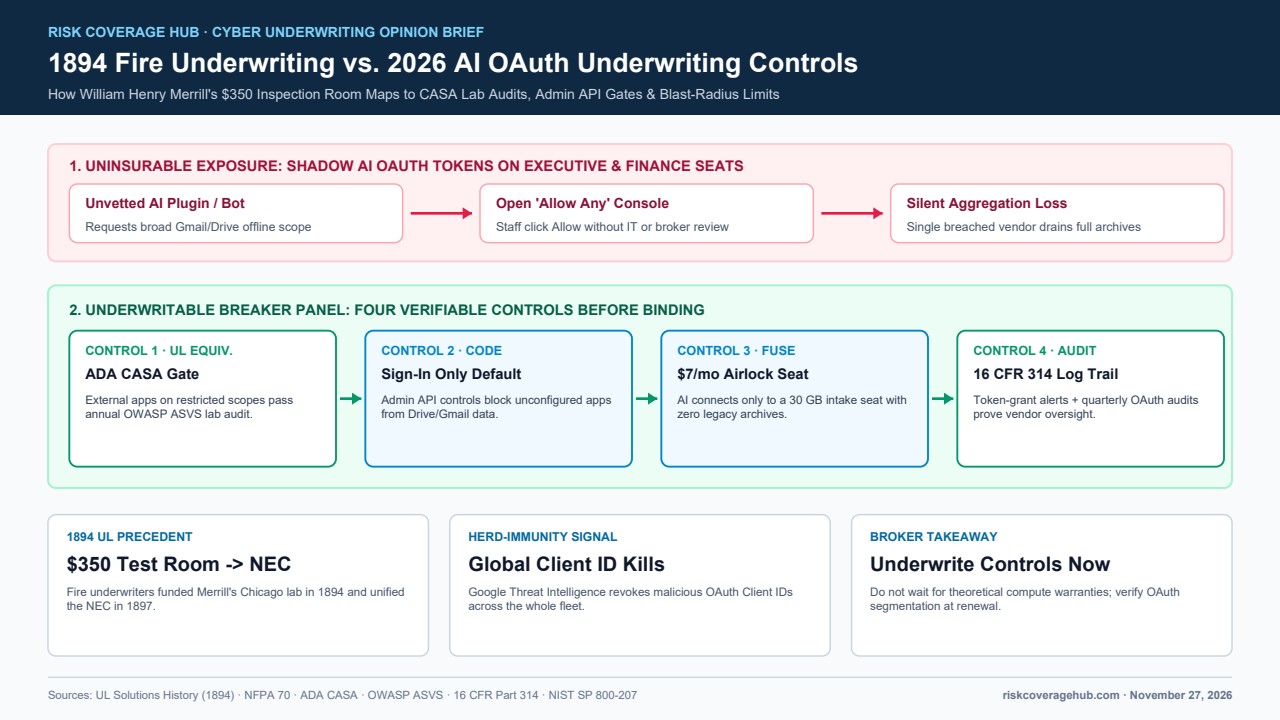
Direct Answer: Fire insurers solved rampant electrical blazes after the 1893 Chicago World’s Fair by refusing to bind coverage without independent testing, founding Underwriters Laboratories in 1894 and unifying the National Electrical Code in 1897. Cyber underwriters face an identical OAuth wiring gap today, which brokers can mitigate immediately with CASA-verified apps and isolated Workspace airlock accounts.
When we looked at whether certified compute warranties cross into insurance underwriting, the core tension was clear: frontier AI vendors sell probabilistic power, yet commercial insurance policies still struggle to verify who actually stood behind the execution wire. While cryptographic compute warranties remain a future design concept, commercial cyber brokers and underwriters do not get to wait five years for theoretical standards. Every renewal packet hitting an underwriter’s desk right now belongs to an insured whose staff is plugging third-party AI assistants, meeting notetakers, and automation bots straight into company email and cloud drives.
In my view, cyber insurance is sitting in the exact seat property fire syndicates occupied in 1893. And the way those nineteenth-century underwriters solved their crisis tells us why locking AI connectivity behind a controlled Google Workspace OAuth panel is becoming an underwriting baseline.
How Fire Underwriters Stopped Wiring Fires Without Inspecting Every Toaster
During construction of the 1893 World’s Columbian Exposition in Chicago, more than 100,000 incandescent bulbs and early alternating-current circuits lit up plaster-and-timber halls—and kept sparking fires. Governments did not write the first electrical safety rules; fire insurance syndicates did, because they were the ones holding the policy limits. As UL Solutions records in its founding history, those insurers hired a twenty-four-year-old MIT-trained electrical engineer named William Henry Merrill Jr. to inspect the fairgrounds. In 1894, backed by fire underwriters, Merrill opened a testing lab above Chicago Fire Patrol Station No. 1 on $350 worth of equipment. Three years later, insurers and engineers unified competing local rules into the 1897 National Electrical Code (NFPA 70).
That history matters because underwriters did not try to personally audit every lamp socket in Chicago. They insisted on two structural guarantees: independent lab testing before equipment hit the market, and standardized branch protection inside the building starting with Edison's enclosed sacrificial lead-wire fuse. Once those two pieces existed, property fire underwriting scaled across an entire industrial economy.
| Fire Underwriting Era (1893–1897) | What Underwriters Faced | Cyber Underwriting Era (2026) | Verifiable OAuth Control |
|---|---|---|---|
| 1893 Chicago World's Fair | 100,000+ incandescent lamps and unvetted AC wiring sparked construction fires | Rapid SaaS and AI agent adoption across mid-market insureds | Inventory every third-party OAuth Client ID granted Workspace tokens |
| William Henry Merrill Jr. ($350 Lab, 1894) | Fire syndicates funded independent testing above Fire Patrol Station No. 1 | Brokers cannot pentest 40 AI vendors on a $15,000 cyber account | Require App Defense Alliance CASA (OWASP ASVS) validation for restricted scopes |
| Edison Safety-Conductor (US227226) | Enclosed sacrificial lead wire melted safely inside an insulated tube | Primary admin/founder seats hold years of PII, banking, and password resets | Isolate third-party AI intake on a dedicated $7/mo Workspace airlock seat |
| 1897 National Electrical Code (NFPA 70) | Replaced conflicting city rules with one standardized wiring code | Unconfigured SaaS portals leave 'Allow any OAuth app' enabled by default | Lock Admin API controls to Sign-in only and enforce drive.file / draft-only scopes |
Why Google's CASA Gate Is the Closest Living Equivalent to the 1894 UL Stamp
Ask any broker running a mid-market cyber evaluation what happens when an insured buys five new AI SaaS tools in a quarter: nobody on a small IT desk—and certainly no carrier writing a $15,000 primary cyber policy—has time to pentest forty startups. Yet every unvetted OAuth token granted to an external AI bot acts like bare overhead wiring crossing into the client’s crown-jewel mailbox.
That is why forcing third-party AI apps through Google Workspace OAuth controls changes the underwriting risk profile so sharply. When an external vendor requests restricted Gmail or Drive scopes and processes that data on outside servers, Google requires an annual App Defense Alliance CASA assessment built on OWASP ASVS and conducted by a Google-authorized third-party lab. In plain underwriting terms, Google acts as the independent testing lab screening out unvetted wrappers before a single employee can bind them to production mail. Even better, when Google Threat Intelligence detects a malicious OAuth Client ID anywhere across its global tenant base, it revokes that Client ID across every Workspace domain at once—giving mid-market insureds enterprise-grade herd immunity they could never buy standalone.
The Shared-Responsibility Catch: A UL Breaker Still Fails If You Bypass It
As we noted when analyzing whether cyber policies respond to cloud vendor outages and what brokers do when AI limits do not exist, putting Google in the middle does not transfer liability onto Google’s balance sheet. Under Google’s shared responsibility posture, Google secures transport, enforces CASA testing on restricted apps, and revokes malicious OAuth Client IDs globally—but Google cannot stop a legitimate user from clicking Allow if the insured’s admin panel is left wide open. A UL-listed breaker panel still lets a building burn down if an amateur bypasses the branch circuit and clamps wires straight onto the main meter lugs.
| Supplemental App Question | Weak 'Yes' (Extension-Cord Risk) | Strong Underwriting Proof (Breaker Panel) | Statutory / Standards Anchor |
|---|---|---|---|
| Third-Party AI App Governance | Employees authorize any AI notetaker or assistant via click-through OAuth | Admin Console restricts unconfigured apps to basic Sign-in only; explicit allowlist | Google Workspace Admin API Controls |
| Vendor Security Validation | Vendor self-attests privacy on a marketing landing page | Vendor clears annual third-party CASA lab audit for Gmail/Drive scopes | App Defense Alliance CASA / OWASP ASVS |
| Token Blast-Radius Limit | AI tools hold broad read/write tokens on executive or finance mailboxes | AI interacts strictly with a $7/mo sacrificial seat holding 0 legacy archives | NIST SP 800-207 Zero Trust Containment |
| Service-Provider Oversight | No written inventory or periodic review of connected SaaS tokens | Quarterly OAuth token-grant audit log export tied to incident revocation plan | 16 CFR Part 314.4(f) Safeguards Rule |
Four OAuth Controls Every Broker Should Put on Renewal Checklists
Rather than waiting for bespoke AI underwriting algorithms or statutory safe harbors, brokers can sharpen submission quality today by helping insureds document four simple Workspace breaker controls:
- 1. Lock unconfigured apps to Sign-in only: In Workspace Admin API controls, prevent employees from granting unvetted AI tools Drive or Gmail scopes without explicit admin allowlisting.
- 2. Isolate external AI onto a $7/mo sacrificial seat: Keep historical customer PII, legal threads, and banking resets on primary seats while external AI reads strictly from a 30 GB intake account.
- 3. Enforce Zero Trust least-privilege scopes: Align with NIST SP 800-207 by insisting on per-file drive.file or draft-only permissions rather than blanket mailbox access.
- 4. Export quarterly OAuth token logs: Maintain an auditable record of connected Client IDs and rapid revocation drills supporting 16 CFR Part 314.4(f) vendor oversight.
In 1894, fire insurers did not ask policyholders to promise they would be careful with bare copper wire. They required a testing stamp and a breaker panel. Cyber underwriting is reaching that exact inflection point on AI OAuth—and a seven-dollar sacrificial Workspace fuse box is the fastest way for an insured to meet the standard.
To pair that underwriting proof with an actionable tabletop exercise for severing a compromised vendor token in under 60 seconds, see Continuity Hub’s Zone A vs. Zone B OAuth cutover runbook covering NIST SP 800-34 contingency detection and Apps Script RPO queue replay.
Frequently Asked Questions
How did fire insurers actually create Underwriters Laboratories in 1894?
During construction of the 1893 Chicago World's Fair, frequent electrical fires alarmed fire insurance syndicates. They hired MIT-trained engineer William Henry Merrill Jr. to inspect the wiring; in 1894 he opened a $350 testing room above Fire Patrol Station No. 1 that grew into Underwriters Laboratories.
Why does Google's CASA requirement matter to cyber insurance underwriters?
Underwriters cannot audit every niche AI startup an insured connects to company email. Google's CASA program requires external apps requesting restricted Gmail or Drive scopes to pass annual OWASP ASVS testing by an authorized third-party lab, giving carriers an existing vetting gate.
Does connecting AI through Google Workspace transfer liability to Google?
No. Google operates under a shared responsibility model: Google secures the infrastructure, threat-blocks malicious Client IDs globally, and enforces CASA vetting, while the insured remains responsible for restricting unconfigured apps and separating crown-jewel seats from sacrificial AI seats.
How does a $7/month sacrificial Workspace seat improve cyber insurability?
By placing third-party AI tools onto a dedicated airlock seat with zero legacy archives and narrow drive.file scopes, an insured caps potential exfiltration blast radius and aligns with FTC Safeguards Rule service-provider oversight under 16 CFR 314.4(f).
Primary Verification Sources
- UL Solutions — 1893 Chicago World's Fair & William Henry Merrill Jr. History
- NFPA — National Electrical Code (NFPA 70) Standards Access
- U.S. Patent 227,226 — Edison Safety-Conductor for Electric Lights (1880)
- App Defense Alliance — CASA Cloud Application Security Assessment
- OWASP — Application Security Verification Standard (ASVS)
- Google Cloud Help — OAuth App Verification & Annual Security Audits
- Google Workspace Admin Help — Control Third-Party App Access
- eCFR 16 CFR Part 314 — FTC Standards for Safeguarding Customer Information
- NIST SP 800-207 — Zero Trust Architecture