Every enterprise buying frontier AI inference today transacts on bearer instruments. Present a valid API secret or OAuth token at a model endpoint, and the meter runs—whether the caller is an authorized workflow or an external attacker draining harvested credentials. Tokens carry no spend-time issuer watermark, enforce no unit-level replay lock, and come with zero balance-sheet backing when hijacked keys run up inference bills.
That exposure motivates an analytical risk-transfer model: certified compute. For underwriting clarity, set the market baseline immediately: certified compute is neither a live vendor tier, an active cryptographic protocol, nor a filed policy endorsement today. As a proposed structure, it asks how loss allocation shifts if an identified frontier lab mints verifiable compute units, watermarks each unit at spend-time, enforces single-use replay locks, and puts its own balance sheet behind counterfeit or replayed spend.
Commercial brokers, risk managers, and cyber underwriters recognize that final promise immediately. Watermarking and replay locks are engineering controls; standing behind the token with capital is underwriting. Just as silent AI exposures are forcing carriers to redraw policy boundaries, any lab promising to make buyers whole on compromised compute steps onto regulated risk-transfer turf—where every guarantee carries an actuarial load, a claims audit trail, and hard exclusions.
Download the Certified Compute Underwriting & Renewal Brief
16 CFR § 700.11 warranty-versus-insurance boundary, and six renewal controls for risk managers.The Uninsured Meter-Burn Problem: What 60 Days of Loss Receipts Show
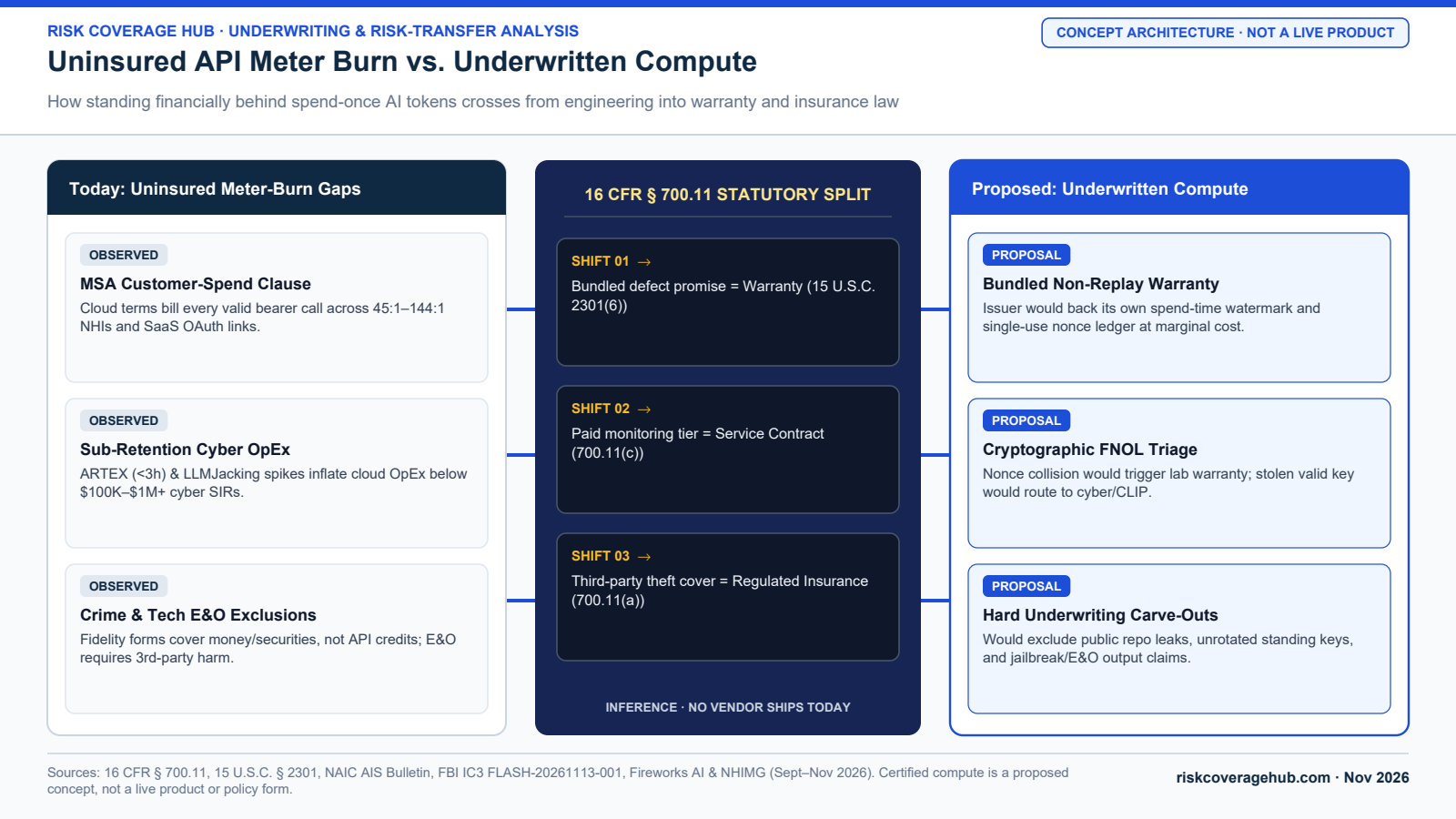
To see why corporate insureds would evaluate guaranteed compute, look at where actual enterprise AI losses accumulated between September 15 and November 14, 2026. Inside corporate environments where Non-Human Identities (NHIs) dwarf human headcount by 45:1 to 144:1, The State of NHI and AI Agent Breaches Report and Cloud Security Alliance OAuth findings show that 44% of analyzed AI compromises stemmed from stolen or misused credentials and roughly 30% (71 of 239) traveled through third-party SaaS and OAuth connectors—routing straight around prompt-layer defenses.
Threat campaigns are now monetizing those harvested secrets directly into inference capacity. On November 13, 2026, FBI IC3 issued FLASH-20261113-001 after Amazon MadPot and Amazon Threat Intelligence (October 3–November 5, 2026) documented autonomous ARTEX agents completing end-to-end intrusions inside three hours while looting active keys from LiteLLM and One API routing proxies to bankroll their own model calls. Vendor-side aggregation risk surfaced in parallel at inference host Fireworks AI, where two separate October incidents—an October 6 “LLMJacking” compute-theft intrusion and an October 23–24 R&D lateral pivot examined by Unit 42—reached downstream SaaS credentials and exposed fewer than 1% of Notion customer chat logs (TechCrunch).
For CFOs and risk managers, stolen-key self-funding creates an uninsured meter-burn loss distinct from non-malicious infrastructure halts that stamp an overt downtime clock—such as Microsoft’s November 12–14 network-capacity configuration outage (MO1550821, lasting over 24 hours across 74+ countries), the U.S. FAA’s November 13 four-hour, 20-minute ground stop (3:54–8:15 p.m. EST, traced by a DHS/DOT briefing to 1980s copper-to-fiber maintenance), or Google Cloud’s October 20 europe-west2-b outage (6 hours 8 minutes after a grid fault and PLC sensor wiring flaw drained UPS batteries in roughly 7 minutes). None of those three outages involved a cyber pathogen, yet each started a measurable business-interruption waiting-period clock. Parasitic API drain, by contrast, keeps endpoints online while quietly inflating monthly cloud operating expense (OpEx)—falling between four standard contract and insurance lines.
| Contract or Policy Line | How Stolen-Key Meter Burn Presents | Standard Wording or Retention Barrier | Typical Recovery Today |
|---|---|---|---|
| Cloud / Model API Terms | Valid bearer key authenticates external agent calls | Shared-responsibility terms treat any call signed with customer credentials as authorized spend | Zero refund unless the provider’s own platform was breached |
| Standalone Cyber Policy | Unauthorized API usage spikes cloud OpEx without encrypting hosts or halting operations | No outage trigger; losses fall below $100K–$1M+ retentions or lack utility-fraud / cryptojacking sublimits | Absorbed in OpEx or capped by narrow utility-fraud sublimits |
| Commercial Crime / Fidelity | Autonomous agent consumes metered credits via harvested LiteLLM or OAuth keys | Computer-fraud clauses cover direct theft of money, securities, or tangible property—not bearer API compute | Routine denial over currency and property definitions |
| Tech E&O / Professional Liability | Internal engineering proxy leaks pooled production keys | Third-party liability trigger requires external client harm; silent-AI exclusions restrict generative AI loss | No first-party coverage for self-funded compute drain |
When brokers run a mid-market cyber insurance evaluation or audit a buyer’s commercial policy map, stolen API meter burn routinely stays on the buyer’s income statement—below cyber retentions, outside commercial crime definitions, and excluded from AI-constrained E&O towers.
Warranty, Service Contract, or Regulated Insurance? The Statutory Trilemma
Suppose a frontier AI lab proposes to close that gap with certified compute: watermarked at spend-time, cryptographically spendable once, and financially backed by the issuer. Under NIST SP 800-39 (Managing Information Security Risk), technical replay locks execute risk mitigation, whereas absorbing residual loss executes a risk response of risk sharing or transfer. Once financial indemnification enters the contract, U.S. law poses a threshold test: is the issuer offering a warranty, a service contract, or unlicensed insurance?
While the Magnuson-Moss Warranty Act (15 U.S.C. § 2301) governs tangible consumer goods directly, the Federal Trade Commission’s interpretive rule at 16 CFR § 700.11 codifies the three-part architecture—paired with state McCarran-Ferguson authority—that commercial counsel and state insurance regulators apply to tech guarantees:
| Instrument Structure | Statutory & Regulatory Benchmark | Pricing & Consideration Rule | What Certified Compute Could Legally Cover |
|---|---|---|---|
| Bundled Product Warranty | 15 U.S.C. § 2301(6); 16 CFR § 700.11(b) | Included in base token price as “basis of the bargain” with no separate fee | Intrinsic defects in the lab’s own token or ledger: duplicate nonce minting, broken watermark, or endpoint replay validation failure |
| Paid Service Contract | 15 U.S.C. § 2301(8); 16 CFR § 700.11(c) | Requires separate consideration (per-token surcharge or post-sale enterprise tier) | Ongoing ledger monitoring, revocation SLAs, and cryptographic audit logs—without indemnifying external theft |
| State-Regulated Insurance | 16 CFR § 700.11(a); McCarran-Ferguson state codes | Actuarial premium backed by statutory surplus and filed policy forms | Fortuitous third-party perils: external ARTEX key theft, compromised SaaS OAuth tokens, or proxy drain where the token had zero defect |
That statutory boundary dictates how any certified compute proposal would have to price. Promising that the lab’s own cryptographic ledger will never clear the same token twice is a bundled performance warranty. Charging an enterprise surcharge to reimburse customers when an external attacker steals valid keys from a LiteLLM gateway indemnifies a fortuitous external peril unrelated to any token defect. Absorbing fortuitous third-party theft for consideration constitutes state-regulated insurance—requiring a licensed fronting carrier or a Contractual Liability Insurance Policy (CLIP) backing the lab.
Two regulatory frameworks reinforce that constraint. Under the NAIC Model Bulletin: Use of Artificial Intelligence Systems by Insurers, carriers using third-party AI telemetry in underwriting, pricing, or claims must maintain written AIS governance, validation, and vendor audit rights—subjecting any compute certifier’s ledger to market-conduct scrutiny. Meanwhile, at the systemic tier tracked by the U.S. Treasury Federal Insurance Office (FIO), frontier labs self-insuring stolen compute across thousands of enterprises would concentrate correlated cyber aggregation on unregulated tech balance sheets rather than treaty reinsurance.
Anatomy of a Certified Compute Claim: From FNOL to Subrogation
If certified compute launched alongside a CLIP-backed theft endorsement or cyber policy integration, how would a disputed meter-burn claim actually run? Unlike traditional step-by-step cyber insurance claims centered on extortion chats, adjustment would turn on cryptographic receipts and multi-party subrogation.
- First Notice of Loss (FNOL) and Token Freeze: Upon detecting anomalous spend velocity, the insured would trigger emergency credential revocation within a 24-to-72-hour policy notice window, locking immutable gateway logs, OAuth grant histories, and signed spend receipts instead of waiting on monthly billing summaries.
- Spend-Receipt Forensics and Nonce-Collision Triage: Adjusters would verify two NIST primitives: the single-use cryptographic nonce (preventing replay) and signer non-repudiation (proving origin and integrity). A nonce collision—two billed runs sharing one single-use nonce, or an unissued watermark clearing validation—would prove a certifier defect and trigger a warranty credit. Conversely, unique nonces signed by a stolen proxy secret would prove the token worked as designed, routing the claim into first-party cyber or crime insurance.
- Three-Way Supply-Chain Subrogation: After paying the claim, recovery counsel would pursue fault across the stack—mirroring accountability disputes when enterprise software fails. Subrogation would target the model issuer (if platform compromises like October’s Fireworks AI breaches exposed keys), the API gateway (if LiteLLM or One API middleware leaked pooled secrets), or the OAuth SaaS vendor (driving roughly 30% of AI breaches)—where recovery collides with 12-month MSA fee caps.
- Wholesale-Versus-Retail Valuation: A certifying lab honoring an internal warranty would replace burned tokens at marginal GPU cost, whereas a third-party cyber insurer reimbursing cloud invoices would pay retail token rates—a spread that would directly shape deductibles and coinsurance.
The Inevitable Exclusions: What Neither Labs Nor Carriers Would Pay For
Every risk instrument defines its real price through exclusions. Just as ransomware claims produced mandatory MFA and offline-backup warranties, neither a certifying lab nor a backing carrier would write open-ended coverage over bearer credentials. As 2026 cyber underwriting hardens around AI, three exclusions would be inevitable in any certified compute form.
- Plain-Text Repository Exposure: Committing live API secrets to public Git repositories, embedding keys in browser bundles, or logging unencrypted tokens in CI/CD pipelines would void recovery under minimum-security-control warranties—the AI equivalent of open RDP.
- Unrotated Standing Keys and NHI Sprawl: With NHIs outnumbering humans 45:1 to 144:1, underwriters would mandate Zero Standing Privilege (ZSP) controls—such as roughly 30-second single-use scoped tokens inside sandboxes—excluding losses from static root keys or ambient email/Slack OTP approvals.
- Prompt Injection, Post-Training Backdoors, and Semantic Output Harm: Actuarial models cannot price unbounded natural-language behavior inside a token warranty. NIST’s June 2026 Gödel incompleteness proof established mathematically that static rule sets leave unavoidable blind spots across open-ended prompt inputs; hardware enclave research (
arXiv:2603.05786) confirms TEEs verify binary execution while providing zero semantic immunity against adversarial text; and Microsoft’s November 2026 “Lazarus” study demonstrated that altering under 10 dormant neurons in open-weight models cleared pre-deployment safety checks yet fired hidden triggers at an 84.1%–98.8% rate. Any insurable compute contract would therefore carve out customer-altered weights and route downstream jailbreak or hallucination damages back to Tech E&O.
Actuarial Pricing and What Underwriters Will Ask at Renewal
If a frontier lab eventually builds certified compute—structured as a bundled non-replay warranty plus an optional CLIP-insured theft tier—its per-million-token surcharge would follow actuarial math: OAuth breach frequency, revocation speed against sub-three-hour ARTEX intrusions, and reinsurance load. Enterprises enforcing ephemeral token brokers would earn preferred tiers; buyers pooling static keys across dozens of SaaS apps would face surcharges or declinations.
Risk managers and brokers do not need to wait for certified tokens to face that underwriting exam. Supplemental AI renewal questionnaires are already probing how many NHIs touch external endpoints, whether hard dollar-velocity circuit breakers kill runaway spend below cyber retentions, whether OAuth connectors face token-exfiltration audits, and whether utility-fraud endorsements explicitly name inference hijacking alongside cryptojacking.
Would you pay a premium for compute someone will answer for — and what would your insurer ask about the keys you’re running today?
Frequently Asked Questions
Can corporate buyers purchase a certified compute warranty or policy endorsement today?
No. Certified compute—tokens minted by an identified lab, watermarked at spend-time, locked to a single spend, and backed financially against counterfeit or replay loss—is an analytical risk-transfer model, not an available AI tier, technical standard, or filed insurance endorsement.
Are stolen AI API keys and LLMJacking bills covered under standard cyber insurance?
Rarely in full. Unauthorized API consumption bills as variable cloud OpEx without halting operations, often landing below $100K–$1M+ cyber retentions or outside policy triggers unless an explicit utility-fraud or compute-hijacking sublimit endorsement is attached.
Why would an AI lab reimbursing stolen-key compute face state insurance regulation?
Under 16 CFR § 700.11 and state McCarran-Ferguson insurance codes, a bundled warranty covers intrinsic defects in the maker’s own product. Charging a fee to indemnify buyers against fortuitous third-party theft crosses into regulated insurance underwriting, requiring a licensed carrier or Contractual Liability Insurance Policy (CLIP).
How would cryptographic nonces and non-repudiation change a compute-theft claim?
Single-use cryptographic nonces and signer non-repudiation separate protocol defects from credential theft. A duplicate nonce proves the lab’s ledger failed (a warranty credit), whereas unique nonces signed by a stolen proxy key prove third-party intrusion (a cyber insurance claim).
Would certified compute cover losses from prompt injection or hallucinated AI outputs?
No. Spend-time certification proves execution custody—who paid for and ran the token once—not semantic safety. Downstream client damages from jailbreaks or flawed AI outputs remain governed by Tech E&O and affirmative AI liability coverage.
Primary Receipts & Official Authorities
- FTC Magnuson-Moss Interpretations: Written Warranty, Service Contract, and Insurance Distinguished (16 CFR § 700.11)
- Magnuson-Moss Warranty Act Statutory Definitions (15 U.S.C. § 2301)
- NAIC Model Bulletin: Use of Artificial Intelligence Systems by Insurers
- U.S. Department of the Treasury — Federal Insurance Office (FIO)
- NIST SP 800-39: Managing Information Security Risk (Risk Mitigation vs. Risk Transfer)
- NIST CSRC Glossary: Cryptographic Nonce & Replay Prevention
- NIST CSRC Glossary: Signer Non-Repudiation
- FBI IC3 Flash Alert FLASH-20261113-001 on Autonomous ARTEX Campaigns (Nov 13, 2026)
- Amazon Threat Intelligence on ARTEX AI Agents Stealing Keys to Self-Fund Compute
- Fireworks AI October 2026 Security Incident Update Bulletin (LLMJacking)
- State of NHI & AI Agent Breaches Report (NHIMG)
- NIST Mathematical Proof on Static Guardrail Incompleteness (June 2026)
- Proof-of-Guardrail & TEE Remote Attestation in AI Agents (arXiv:2603.05786)
Save the 2-Page Underwriting & Renewal Checklist
16 CFR § 700.11 warranty boundary, and six non-human identity controls.Coverage & Legal Disclaimer: Risk Coverage Hub publishes commercial risk, underwriting, and policy analysis for informational purposes only and does not act as a licensed insurance producer, carrier, claims adjuster, or law firm. “Certified compute” as analyzed in this article is a proposed conceptual framework, not an existing commercial AI product, technical standard, or filed insurance policy form. Policy terms, retentions, utility-fraud sublimits, and state warranty or insurance regulations vary by jurisdiction and carrier; consult your licensed broker of record or coverage counsel regarding specific wordings.